
Kyoto, Spring 1970
The silk whispered before she did.
The first thing Hana noticed was the sound; the hush of silk sliding beneath her fingers, soft as
breath against the ear. The atelier was still, yet alive with its own quiet rhythm: the faint hiss of
steam from an iron, the murmur of fabric being smoothed, the whisper of a needle through cloth.
Morning light filtered through shōji screens, silvering the wooden floor and making each particle
of dust seem purposeful.
She had been apprenticed here only a month, but already she sensed the room’s strange intimacy.
The kimonos hung from lacquered rods like slumbering souls; even their silence seemed charged,
waiting. Her master, Ishikawa-sensei, believed that every garment carried a kokoro — a heart.
“Treat them as you would the living,” he often said.
When the day’s work ended and the other apprentices left, Hana lingered, sweeping stray threads
from the tatami. That was when she first heard it — a whisper. Faint, deliberate, impossible to
place. It seemed to come from the row of finished kimonos along the wall, a breath of words in a
language older than memory.
She froze, listening. Nothing. Only the wind teasing the paper screens. She laughed at herself,
closed the lamps, and bowed before leaving. But the whisper followed her out — light,
persistent, like fabric remembering the shape of the body it once touched.
The next evening, the sound returned. This time she pressed her ear close to the hanging
garments. The violet kimono murmured something like a sigh; the crimson one gave a sound
almost like laughter. Each seemed to hold the ghost of its wearer.
All except one.
At the end of the row hung a bolt of pale ivory silk patterned with faded cranes. It was beautiful
but wrong — the color uneven, the threads slightly scorched, the edges frayed as if touched by
fire. When Hana brushed it, warmth pulsed beneath her fingertips.
She carried it to Ishikawa-sensei’s table.
“Put that away,” he said without looking up. “It is not for use.”
“It’s extraordinary,” she said. “The weave feels alive.”
He sighed, lowering his spectacles. “Alive, yes — but not for the living. That fabric was ordered
in the spring of 1945. The woman who commissioned it never returned. A bomb fell near her
home in Osaka. The silk came back scorched. I keep it as a reminder: some silences must not be
broken.”
He rolled the bolt back carefully, his hands trembling with age. “Do not touch it again.”
Hana bowed, but that night she dreamed of ivory silk drifting through smoke, and a voice singing
a lullaby she half-remembered from childhood.
Days passed. Sakura petals gathered in the gutters like folded prayers. Hana continued her work
— dyeing, stitching, steaming — yet her eyes kept returning to the ivory bolt. The other fabrics
whispered when she handled them, faint stories of brides, dancers, and mourners. The ivory silk
remained mute.
One afternoon, as she sorted the atelier’s record books, she found an old ledger wrapped in
brown paper. Inside, written in the faded ink of the wartime years, was an entry:
Client: Yoshiko Takahashi
Garment: Wedding kimono, ivory cranes, silk imported from
China.
Status: Commission incomplete.
Hana felt her breath catch. Takahashi. Her mother’s maiden name.
Her grandmother had vanished in the final months of the war, leaving behind a single photograph
— a young woman with gentle eyes, standing beside a loom. No one in the family ever spoke of
her.
She went to Ishikawa-sensei and showed him the ledger. He studied it in silence, then looked at
her as though seeing her for the first time.
“So,” he said softly. “You are Yoshiko’s granddaughter.”
He told her that Yoshiko had worked in the same atelier before the war — a gifted seamstress,
quiet but meticulous. She’d ordered the ivory silk for her own wedding kimono, planning to
finish it herself. When the bomb fell, she was gone. Only the damaged bolt returned.
“She was the last apprentice before me,” Ishikawa said. “I learned everything from her. When I
tell you not to break certain silences, it is not superstition. It is mercy.”
But mercy, Hana thought, could also be a cage.
That night she carried the ivory silk to her table. The atelier was dark except for the glow of a
single lamp. The air smelled faintly of persimmon and rain.
She unrolled the fabric, revealing a long tear where the weave had split — a wound across its
center. She traced it with her finger.
“Grandmother,” she whispered.
No answer. Only the stillness of Kyoto after midnight.
In the following days, she visited the craftsmen at a nearby temple who practiced Kintsukuroi —
the mending of broken pottery with lacquer mixed with powdered gold. She watched as they
brushed gold along the cracks, turning scars into veins of light.
“The break is part of the story,” one monk told her. “To mend is not to hide. It is to honor what
has been broken.”
When she returned to the atelier, Hana resolved to mend the silk — not with lacquer, but with
thread. She dyed fine strands in a solution of gold dust and rice glue until they shimmered like
sunlight through water. Then she began to sew.
As the needle passed through the torn silk, she heard it — a sound softer than breathing. A voice,
barely audible, humming a melody her mother once sang. The tune was old, tender, and
unbearably familiar.
She worked until dawn, guided by that whisper. It never frightened her. It was the sound of
something mending itself.
By spring’s end, the kimono was complete. The ivory fabric shone faintly under the courtyard
lanterns, the gold stitching glimmering like veins of morning light. The atelier opened its doors
for the hanami festival, displaying its finest works. Visitors admired the new kimono’s subtle
patterning, the fusion of age and renewal.
Ishikawa-sensei stood beside her, his eyes moist. “You have done what I could not,” he said.
“You have given the silence a voice.”
She bowed. “It was already speaking. I only learned how to listen.”
He smiled. “And what did it say?”
Hana glanced toward the kimono as a breeze lifted its sleeves. The cranes seemed to stir within
the silk, their wings catching the gold seam of light.
“It said arigato,” she whispered.
That night, alone in the atelier, Hana folded the kimono into a cedar chest. The fabric felt warm,
as though still breathing. Outside, the wind moved through the garden bamboo, carrying faint
murmurs that might have been voices or might have been the sigh of spring.
She touched the repaired seam one last time.
The whisper rose again, not sorrowful now but serene — a final exhalation that seemed to come
from the world itself.
She bowed deeply, extinguished the lamp, and left the room to its silence.
Two years later, Kyoto, Spring 1972
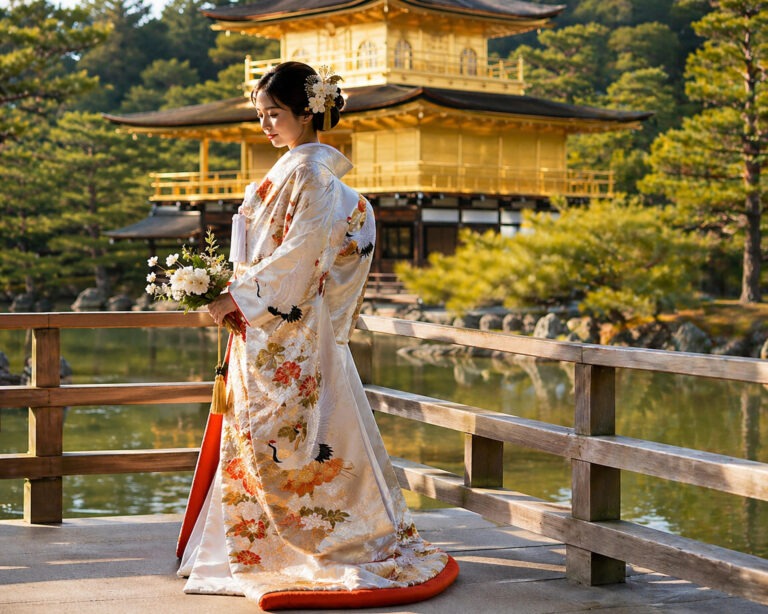
Beneath the reflection of the Golden Temple, Kinkaku-ji, Hana stood in the gardenpond’s serene light, wearing her grandmother’s restored silk as her wedding kimono. The gold-threaded cranes shimmering in flight, the mended seams now as whispered vows kept across generations.
Whispered Haiku
Gold fills every scar—
The heart learns its final stitch;
Silence hums again.