
Lyon France 2010-2012
The apartment at 18 Rue du Président Édouard Herriot smelled of onions, butter, and cumin that first autumn. It was a cramped place: slanted ceilings, an antiquated loud radiator, with windows that looked across the rooftops of Les Cordelies neighborhood.
Yoon had found the apartment through a notice pinned on the Cordon Bleu Culinary Institute’s bulletin board. When she opened the door that first day, Marisol and Aziza were already arguing in halting French about which cupboard belonged to whom. Yoon took off her beret and introduced herself with a polite bow. Marisol, laughing, took her hand without hesitating. Aziza nodded reservedly; but her dark eyes softened once Yoon set a jar of gochujang paste on the counter as though she were Anna presenting the King of Siam with a gift.
Aziza called herself a “cultural Muslim,” more faithful to memory than to ritual. She still fasted the first day of Ramadan out of respect for her mother, but she also believed that God smiled on good wine and honest laughter.
That night they cooked together for the first time—boeuf bourguignon. The kitchen filled with steam, laughter, and the mingled scent of butter and wine. The preparation was chaotic, but it turned out perfect. For Aziza, French food paired with wine was like couscous and harissa, or salt and pepper—one could not survive without the other. They ate sitting cross-legged on the floor, a hearty vin de table staining their lips, each pretending not to notice when the other cried from homesickness.
Their days became a rhythm of chopping, slicing, and whisking. With morning cooking demonstrations and afternoons lost in the dusty cellars of Beaujolais wineries, France wove its way into their hearts. They argued about sauces and memorized wine appellations. On most days, they walked home along cobblestoned alleys under sprinkling gray skies while dodging rain puddles. A favorite stop after class became carrying home a freshly baked baguette from the local boulangerie that was warm enough to offset winter’s chill.
At night, the apartment filled with the sounds of languages that refused to stay separate. Spanish bled into Korean, Arabic into French. The resonating gong of the hourly bells from the Gothic Cathédrale Saint-Jean-Baptiste reminded each woman of their deepening friendship.
There were nights when exhaustion made them slump in silence. On those nights, Yoon would brew boricha — barley tea; Marisol would hum her favorite Julietta Venegas song, Lento, and Aziza would read Moroccan author Tahar Ben Jelloun’s The Sand Child. It was enough to keep despair outside the door.
Their instructors taught them discipline: the secret language of forks and knives, plating like geometry, the perils of soufflés, and the politics of Michelin stars. But in their apartment, they learned tenderness. When Yoon failed a sauce exam, Marisol pulled her into a hug and said, “Béarnaise, ne t’en fais pas—we’ll invent our own.” When Aziza wept after a letter from Casablanca, Yoon pressed rice cakes into her hands and whispered, “Eat, then we talk.”
By their second year, they moved as one body in the kitchen. They could pass knives without looking, anticipate when the other needed seasoning or silence. Even their laughter and frustrations had gained a rhythm, rising and falling like a shared breath.
On the eve of graduation, the three of them sat on their rooftop, feet dangling over the slate tiles, sharing a bottle of Veuve Clicquot. Lyon glowed below, the Rhone River splitting the city into deux poulet rôti halves.
“Tomorrow we’ll be chefs,” Marisol said, her voice half-proud, half-terrified.
“Tomorrow we’ll be strangers again,” Aziza murmured.
“No,” Yoon corrected gently. “Tomorrow, we are sisters. Chefs come and go. Sisters stay.”
As the champagne’s effervescence lingered on their palates; the spring night turned brisk, and in that fleeting moment their future felt bright, even endless.
A Week of Grace – September 2024
Their separate flights into Incheon skimmed low over the water — Marisol traveling from México and Aziza from Morocco. Seoul stretched beyond the horizon in a glitter of glass high-rises and bridges. At baggage claim, Yoon greeted them with a silk scarf tied in her hair, waving with both arms as if summoning them home.
Her home stood in the historic neighborhood of Jung-Gu, surrounded by cultural landmarks, street markets, and bustling street food vendors. Yoon’s modern house was all clean lines and sliding doors. The women fell into its warmth with the ease of old rituals; shoes abandoned at the threshold, hugs that transformed into laughter, the kitchen table already set with banchan in small porcelain dishes.
“This week,” Yoon declared, raising a glass of plum wine, “will be for beauty and rest. No knives, no hot ovens. Only us.”
Marisol grinned, clinking glasses. “Then let’s be queens.”
Aziza lifted hers more solemnly. “To sisters.”
The days unfurled like Mahjongg tiles. In the mornings, they wandered through outdoor market stalls. Marisol bought candied chestnuts by the paper bag; Aziza felt at home bartering for decorative Jogakbo patchwork vests. Yoon guided them with the poise of a hostess, pointing out temples, cafés, and the best vantage points for the Han River at dusk.
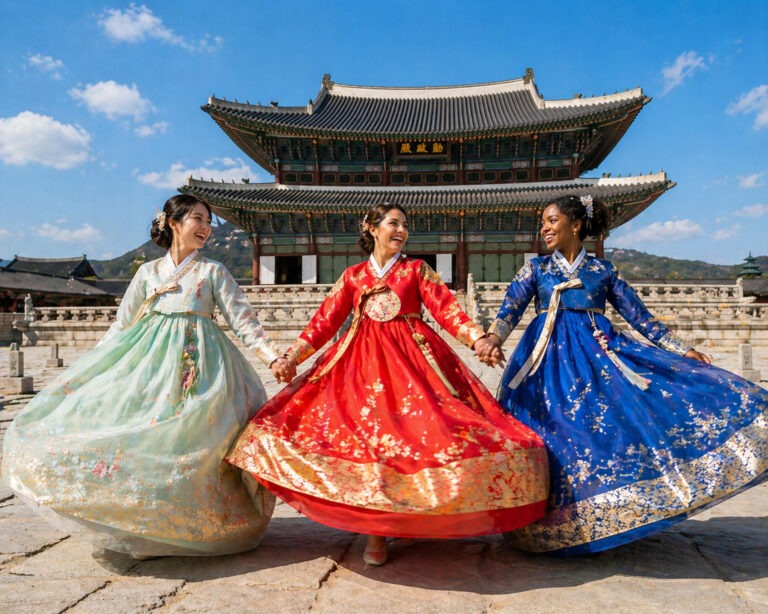
One afternoon, they rented hanbok dresses to celebrate the Korean national holiday, Chuseok. Marisol chose bright vermilion with gold embroidery; Aziza selected sapphire blue. Yoon appeared in pale jade, the ribbons falling like strokes of calligraphy.
At Gyeongbokgung Palace, crowds of tourists snapped photos, but the three women only saw each other. They posed before the high gates, holding hands, spinning until the skirts flared like blossoms.
“Smile!” the photographer instructed in English.
The shutter clicked, catching them mid-laughter, midlife. Three accomplished women who seemed untouched by time.
The spa treatments Yoon had arranged were otherworldly. In a candle-lit room, they lay side by side as attendants brushed fragrant oils over their backs in long, sensuous strokes. Their laughter faltered into sighs. Steam wafted from copper bowls with the scent of ginger and rose.
Marisol reached across, squeezing Aziza’s hand. “I’ve never been this spoiled.”
Aziza closed her eyes. “This is not spoiling. This is paradise.”
Yoon, face pressed into the pillow, murmured, “Salvation should always come with hot stones.”
Later, in the bathhouse, they slipped into pools that steamed like cauldrons. Their bodies floated, hair unpinned, skin luminous beneath the condensation. Their intimacy was natural. They scrubbed each other’s shoulders with mitts, exchanged teasing remarks about who had the smoothest skin, laughed at the absurdity of caring so much about pores and wrinkles. Yet under the laughter was something fragile, an unwelcome hush that trembled when their conversation waned.
Marisol noticed it first, how Yoon lingered with her eyes closed in the hottest pool, as if she were meditating on the sensation. Aziza caught it too, her brow furrowed as she tried to interpret why Yoon seemed somehow distant. But neither said a word.
Evenings were feasts. Yoon prepared jjigae stew with fresh clams, pancakes crisp with scallions, accompanied by bottles of soju that emptied too quickly. Like their former student days in Leon, they sat on the floor, legs crossed, hair still damp from their mineral baths, stories tumbling out faster than they could translate across three languages.
Marisol confessed how exhausted she felt running her restaurant in México City — “I spend more time balancing invoices than stirring sauce.” Aziza admitted she longed for children, though she feared it might dismantle everything she had built in Casablanca.
Yoon listened more than she spoke. When she spoke, her voice was serene, but her eyes carried a glimmer of urgency, as if she were determined to hold each conversation, each burst of laughter, in permanent memory.
One evening, after they finished eating, she reached for her phone and showed them the photo from Gyeongbokgung Palace. The three of them, caught in a prism of color, cheeks flushed, arms entwined.
“This,” she said softly, “is what excellence looks like.”
Marisol said, “Excellence? We’re half-drunk and overdressed.”
“Exactly,” Yoon replied. “Excellence is joy with the people you love.”
Aziza placed her hand over Yoon’s. “Then, let’s never forget.”
The moment lingered. Outside, Seoul hummed with neon and traffic, but within Yoon’s home, there was only warmth and a fragile serenity none of them yet dared to question.
The Final Course
The last evening of their week arrived too quickly, though none of them wished to say so. Yoon prepared dinner herself, brushing aside offers of help, her hands moving with deliberate grace. She roasted fish with soy and ginger, set bowls of pickled radish in neat rows, poured wine with the calm of a host who knew her guests would need courage.
Marisol laughed louder than usual, as if the sound could stretch the night. Aziza fussed with the chopsticks, aligning them repeatedly beside her plate. Yoon waited until their glasses were full before she spoke.
“I have something to tell you,” she said, her voice steady but low. “I didn’t invite you here only to rest. I wanted us together because I may not have much time left.”
The words slid into the room like a thief in the night. For a moment, no one breathed.
“I have pancreatic cancer,” she continued. “It’s already advanced. The doctors … they are honest. Perhaps months, perhaps less.”
Marisol’s glass clattered against the table. “No, no, that can’t—” Her voice cracked, and she pressed her palms against her eyes as though she could blot out the truth.
Aziza whispered a prayer in Arabic, barely audible, her gaze fixed on Yoon’s face. Then, she reached across the table and laid her hand over Yoon’s.
“You should have told us sooner,” Marisol finally said, frustration woven into grief.
“I wanted this week to be joy,” Yoon replied.
Silence followed. The three women sat together, hands linked across the table. Yoon’s eyes shone, but she smiled as if to steady them all.
“Promise me one thing,” she said. “Remember me in the kitchen. Not in a hospital bed.”
They promised, though their voices broke.
~ ~ ~
Two months later, Seoul wore the earthy-toned yellows, browns, and burnt orange of the changing autumn foliage. The funeral was held at a hillside temple within the Namsan Mountain Park. The forest air was crisp with pine and incense. Marisol and Aziza stood side by side among the mourners, both dressed in black, their shoulders brushing as if they were afraid to standalone.
On the altar lay a photograph from Gyeongbokgung Palace: the three women in brilliant hanbok; smiling and laughing, skirts unfurling like cherry blossoms during spring.
When the chanting began, Marisol leaned close and whispered, “That day was her victory.”
Aziza nodded, her eyes wet. “Her excellence.”
They lingered after the others had gone, unwilling to leave. The temple bell rang, deep and resonant, rolling down the steep mountain slope like a final note.
Neither spoke. There was nothing left to say. Only the memory of Yoon’s smile, her hands shaping food, her voice declaring that joy itself was a perfection.
And in that silence, they understood excellence was never about the dishes they cooked, the stars they might win, or the names on their restaurants. It was this; standing together, bound by love, carrying Yoon forward in the quiet rhythm of their lives.