
Act I: The Wedding in the Gallery
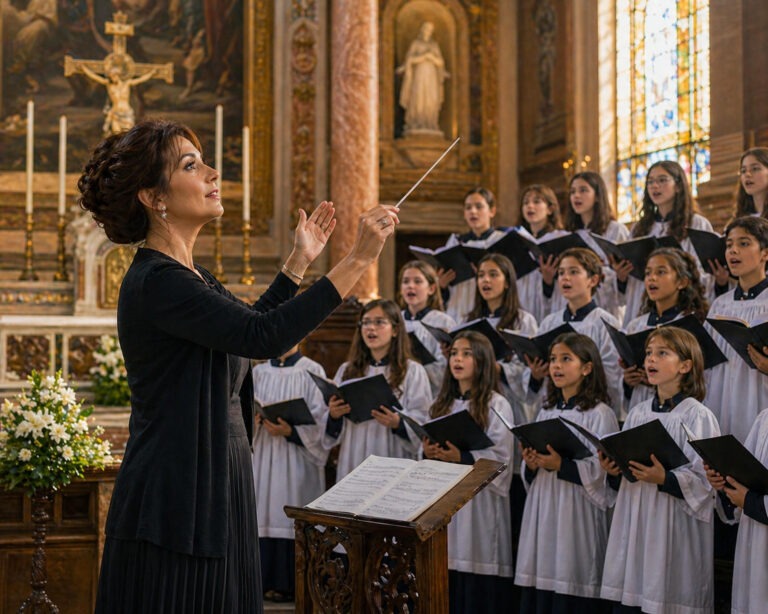
The first notes of Laudate Dominum rose through the high nave of Santa Margarita Assunta, spiraling into the Gothic vault like morning incense. Renata Ferrante stood in the gallery above the marble altar, her hands poised mid-air, the choir’s cadence flowing with the ease of breath long held and finally released. The light through the lancet windows cast bands of amber and blue across the basalt columns, like veils fluttering between this world and something holier.
From her vantage point in the cathedral’s gallery—rebuilt after the 1943 bombings with wood imported from Calabria and ironwork forged in nearby Adrano—Renata could see almost everything. The moss-colored stole of Monsignor Paschi glinting under the nave’s chandeliers. The elaborate floral garlands of wild chamomile, poppies, and Nerello vines twined around each pew. And at the altar, hands joined gently in nervous devotion, Andrea Abate and Chiara Fiorina.
She had led hundreds of Masses. She had trained dozens of sopranos, corrected scores of tenors, endured flat altos and hesitant baritones—but today was different. Today, her two star choristers, grown into their own light, were binding their lives before God and gathered witnesses. She knew every quiver in their voices before they spoke their vows. She had rehearsed their hearts long before they realized the music they were making together.
Renata lowered her baton slightly. Behind her, the choir modulated into its third stanza, voices layered like brocade, each thread distinct but woven to one purpose.
And then, without prompting, memory returned—inevitable as breath.
Ten years earlier, Chiara Fiorina had been thirteen. Already leggy and light-footed, with a soprano voice that hadn’t yet settled, she carried her hymnal like a diary. That first rehearsal, she stood near the back and sang only when she thought no one was listening.
Andrea Abate had been fifteen. Quiet. Intent. His voice, even then, startlingly clear—a bell struck in still air. He arrived punctually every week, carrying his rolled sheet music under one arm like a schoolboy philosopher.
They never stood next to each other. Not at first. But Renata, even then, had noticed how Chiara’s eyes lingered in his direction during warmups. And how Andrea, with great and almost laughable dignity, managed never to return her gaze.
Love, Renata knew, almost never begins with knowing. It begins with not-knowing—why one’s voice lifts when another arrives, why one lingers just a moment too long folding robes in the vestry.
She smiled now, in the gallery, remembering. How could she not? She had witnessed the melody before the lyrics, the cadence before the confession.
It was Monsignor Paschi’s idea to have the choir sing Laudate Dominum at the wedding. He had made the request a month prior, standing in her small office beside the sacristy, thumbing through a dusty copy of Cantate Domino. He hadn’t changed much in the last decade—still favoring his wine dark, his coffee bitter, and his expectations somewhat impossible.
“They met in your choir, after all,” he’d said, smoothing his silk cassock with pride. “What better benediction than for their love to be blessed by sacred music?”
Renata had nodded. She had agreed, of course. But in truth, it was not a favor. It was a culmination.
A gift.
She lifted her arms again.
Below her, Andrea turned his head slightly, just enough to catch Chiara’s smile, the one that had finally bloomed fully at La Infiorata, two years after their last choir rehearsal. Renata had seen them that day, walking near the Via degli Archi, blossoms of blue myrtle and yellow broom drifting like confetti in the breeze. She had watched from a shaded loggia as Andrea leaned in—just enough for his forehead to touch hers, gently, as if cued by invisible music.
That was their first kiss.
And here they were now, voices older, hearts fuller, standing before the altar beneath the gilded arch of the restored apse.
Renata let the final measures rise and settle, a feather landing on still water.
The choir fell silent.
The organist held the last chord, then let it go, like a breath exhaled into the sacred hush.
Renata did not move.
In that suspended moment, she realized she had found something years ago that no opera stage, no critic’s column, and no velvet curtain had ever offered.
She had not only trained voices. She had tuned lives.
Act II: The Echo Beneath the Song
The first time Renata Ferrante laid eyes on Renzzano, it was through the smeared window of a second-class carriage rattling along the Circumetnea railway. The tracks circled Mount Etna like a ribbon drawn around a sleeping giant. Below, groves of citrus trees glistened, and above them, vineyards clung to dark volcanic terraces like green lace on black velvet.
She arrived in early autumn, when the grapes were nearly fat enough to burst. At the edge of the town, she saw workers in straw hats harvesting Nerello Mascalese grapes, their hands deft and stained. The air carried the perfume of fig leaves, fennel blossoms, and woodsmoke curling from kitchen chimneys.
Renzzano was smaller than she had imagined. Quaint without posturing, pious without severity. A village where the cathedral clock chimed not only the hour, but the slow, seasonal rhythm of prayer, harvest, and procession.
She had come with two suitcases, a worn copy of Don Giovanni, and no real plan—only a contract from the diocese to rebuild the children’s choir of Santa Margarita Assunta, and a quiet plea to the universe that this place might offer what Milan had never managed: peace.
The cathedral was astonishing. A symphony in stone. The Gothic-Norman façade of lava rock still bore the scars of Allied bombs, though softened now by time and ivy. Inside, shafts of light pierced the cool air like a benediction. The Latin cross plan, the Renaissance softening of Sicilian Catalan edges, the echo of one’s footsteps across the monolithic basalt columns—it all gave the impression not of grandeur, but of invitation.
Renata had wept quietly the first time she stepped into the apse. Not because of its beauty, but because she felt, for the first time in years, unnamed and unjudged.
Then Monsignor Paschi had arrived.
He had greeted her with the deliberate charm of a practiced aristocrat—offering not a handshake, but his ring, which she pretended not to see. His eyes were keen, calculating, and slightly amused.
“You are the soprano from Verona,” he’d said, studying her face as if it were a libretto in a forgotten dialect.
“Retired,” she corrected.
“Pity. We had hoped for a touch of La Scala. The children will respond to excellence.”
“They’ll respond to patience and warmth,” she said, trying not to bristle.
The Monsignor raised an eyebrow. “They’ll also respond to results. Our bishop enjoys progress reports.”
It was not the beginning of a warm friendship.
Still, she settled into life quickly. She rented a small apartment above a ceramics shop near the Via dei Lanza, with a balcony that overlooked a square of pomegranate trees and church spires. Mornings, she would walk to the Sunday market, where vendors from the Alcantara Valley offered creamy rounds of pecorino, buckets of olives glossy as lacquer, and the greenest zucchini she had ever seen. The women were quick to gossip, the men to flirt, the children to sing without knowing they were singing.
She began to rehearse the choir in the afternoons. At first, the children were shy—some bored, some off-key, all grieving the loss of their beloved Maestro Vittorio, who had passed away two seasons earlier.
Among the new singers were Andrea Abate, whose posture suggested shyness but whose tenor voice surprised even himself, and Chiara Fiorina, all elbows and hesitation, whose first note was a whisper and whose second nearly broke Renata’s heart with its sweetness.
And in the cathedral, Renata began to listen not only to their voices, but to her own.
Act III: Benediction
The courtyard beside Santa Margarita Assunta had been transformed for the wedding celebration. Beneath the vine-draped pergola, long tables were set with white linen and bowls of apricots, almonds, and candied orange peel. Musicians played soft pizzicati on mandolins while the guests mingled between bursts of laughter and the gentle clinking of glasses.
Renata sat beneath a fig tree at the edge of the gathering, a small plate of olives and pecorino untouched beside her. From her seat, she could see Andrea and Chiara moving together beneath the canopy of trailing vines. He was taller now, his boyish hesitancy softened into quiet confidence. Chiara—bare-shouldered, radiant—had an elegance that seemed lit from within.
They danced with the simplicity of people who had already known each other through silence. No spectacle, no show. Only the easy rhythm of familiarity.
As Renata watched them, a memory slipped in—not loudly, but insistently. It was three summers ago. A picnic on the flowered slope of Mount Etna, just above the village, when the broom blossoms had opened in gold and the lupines had begun to sway in the June breeze. Chiara and Andrea had asked to rehearse outside that day—just to try something new, they’d said.
Renata remembered them sitting on a woven blanket, the view of the valley below them like a painting that refused to dry. The children’s music folders sat unopened beside a basket of olives and bread. It was not a rehearsal, and they all knew it.
Andrea had reached toward a fallen petal—a deep violet daisy from a wild tangle of blooms near the edge of the grass—and tucked it behind Chiara’s ear. She had smiled but said nothing. And in that wordless moment, Renata had recognized something she had never known with certainty in her own life: that love could be soft, unannounced, and still last forever.
The music in the courtyard shifted again.
A few guests began to applaud. Andrea leaned forward and whispered something in Chiara’s ear that made her laugh—not from shyness but from joy.
Renata rose quietly, her hand resting for a moment on the fig tree’s warm bark.
“Ferrante,” a voice called gently from behind.
She turned.
Monsignor Paschi was approaching, his cassock brushed with ash-colored shadows from the pergola above. His face, usually drawn with a kind of performative solemnity, looked unguarded.
For a second, she expected some wry remark—something about tempo, or pitch, or the bishop’s musical preferences.
But instead, he stopped beside her, hands loosely clasped.
“Grazie, Renata.”
Just that.
Not Annalisa, not Signorina Ferrante, not our former soprano from Verona. Simply: Renata.
She nodded once, and her eyes, without effort, filled.
Paschi placed a hand lightly on her shoulder, then turned and disappeared into the flicker of candlelit guests.
She stood there for a few breaths longer, then quietly slipped back into the cathedral through the side entrance. The sacristy was still, its air perfumed faintly with lilies and old wood polish. Her heels clicked once, then fell silent as she stepped into the nave.
The great space was empty now. The choir gallery above waited, cloaked in dusk. She walked slowly toward the organ beneath the restored apse—its pipes shimmering like sentinels. No audience. No critics. Only the stones and the silence.
She sat on the bench.
Her fingers hovered above the keys, trembling only slightly. Then, softly, she pressed one note. Then another. A phrase formed.
Puccini. O mio babbino caro.
Not a performance. Not a memory. A whisper of something once lost, now returned.
She hummed a few notes under her breath. The sound lingered, echoed faintly through the nave, then faded.
Renata smiled, and this time, she did not feel the ache of absence. Not for the stages, not for the roles, not for the name she no longer needed.
She rested her hands in her lap.
She had not arrived at greatness. She had arrived at peace.