
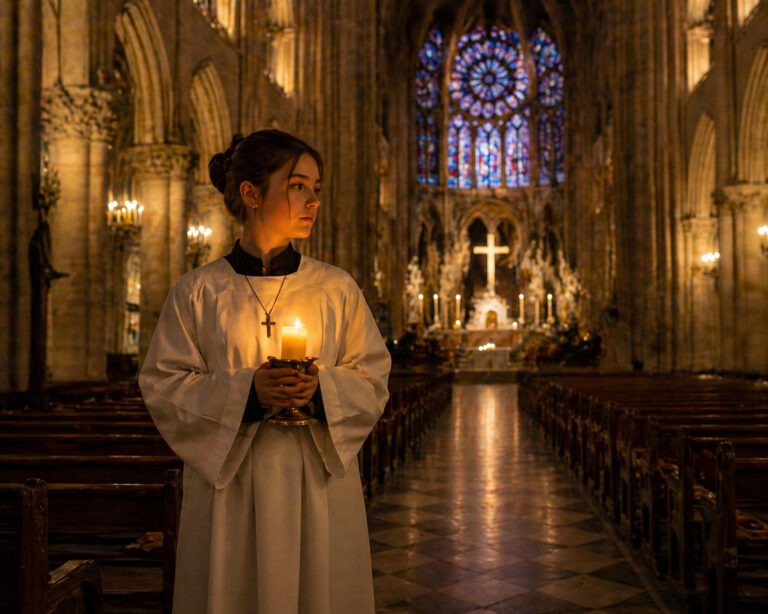
Le Marais, Paris – Before Dawn
Christmas Eve began in Le Marais with rain-polished cobblestones and elegant shop windows decorated in the festive colors of red, green, white, and gold. Camille Durand walked quietly beside her mother along rue Vieille-du-Temple, her cassock folded over one arm and a candle wrapped in brown paper under the other. The wick was unlit, but she could already imagine its glow.
She was twelve; tall for her age, bright-eyed, and serious in the way that made adults think she was older. In their fourth-floor apartment, her grandparents were waiting patiently. Marcel sat at the kitchen table, watching steam lift from his coffee. Josephine pinned a silver cross to the lapel of Camille’s overcoat with the precision of someone who had once packed a life into a suitcase.
The door opened before Camille could knock. Her grandmother drew them in with a brief embrace, then held Camille at arm’s length, as though measuring what had changed since the last visit.
“You’ll walk slowly,” Josephine said. “Notre Dame is not a playground.”
Camille smiled. “Paris is full of people who disagree.”
The entire family: grandparents, parents, her older brother, Jean-Paul, would be seated inside the cathedral for the Christmas ceremony. Even Aunt Juliette was coming, claiming she only attended for the choir saying the music made her feel “nostalgic.”
At collège, Camille was known as the girl who read on the métro instead of taking selfies. Her best friend, Lina, teased her gently about church: “You’re the only person I know who still trusts religion.” Their teacher had assigned an essay after another news segment about the cathedral: What does Notre Dame mean now? Camille’s classmate, Henri, who spoke like a future politician, declared, “It’s just stone. Religion is stories for people who are afraid.” A popular comedian’s blog, reposted thousands of times, showed someone snuffing candles and announcing that humanity had finally defeated darkness by inventing sarcasm.
Camille didn’t argue. She thought of the day of the fire; sirens, smoke, the spire collapsing on live television, and the way her mother had cried without trying to hide it. She had been eight then, old enough to sense that something trusted had been hurt.
On Thursday afternoons she went to religious instruction, where Sister Agnès spoke softly. “A candle is a serious responsibility,” she told the youth acolytes. “You’re not holding wax. You’re holding a point of light in a world that loves distraction.” Once a week, Camille practiced carrying flame without letting it shake, learning that commitment could be attained.
The Cathedral and the Old Departure
That evening, Notre Dame received Paris the way a close family member is welcomed home after a long hospital stay. Inside, the air was cool and ethereal, scented by freshly cleaned stone and floral arrangements of roses, lilies, and poinsettia, Restoration had returned the vaulting to its high purpose, but not to innocence. Scars were not erased; they were made meaningful.
Camille found her family sitting amongst the many worshipers along the central nave, still wearing their winter coats and scarves. Her father’s gaze lifted toward the ceiling as if checking it was real. Josephine grasped her rosary like a secret. Marcel stared at the fresh timber and precise seams, the craftmanship unmistakable.
A choir began singing The Prayer, and sound rose into the arches and came back softened, as though the cathedral itself had learned humility. Near the center aisle, the youth acolytes lined up. One candle was lit from the altar flame, then another, until light traveled hand to hand. When Camille’s wick caught, it made a faint, nervous sigh. A small amber blister gathered around her fingers.
She walked slowly and was suddenly afraid of growing up.
As she walked toward her grandfather, his face had changed, not with pain, but with a look of introspection.
In Marcel’s memory, the cathedral’s stone became the reflection of Algiers in 1960. He was young then, newly married, Catholic in a country splitting itself into deadly slogans and suspicions. He remembered a café radio announcing arrests, bombings, and mayhem spreading throughout the city. Outside, a French soldier smoked with bored authority while a boy watched him with a hatred too large for his body.
Joséphine, then barely twenty, had touched Marcel’s wrist and said, “This will not return to how it was.”
He understood with the clarity of a match struck in a dark cave: the colonial era was ending. Algeria had the right to steer its own destiny, even if the road would be brutal. And they had the right to leave before history demanded a sacrifice.
That night they packed what they could carry. Before dawn they boarded a ship for Marseille, watching Algiers glow behind them, not with candlelight, but with fires that had nothing holy about them.
The choir shifted into a carol. Marcel blinked, and Notre Dame returned. He watched Camille with her candle held steady and remembered another blaze: the cathedral burning, Paris gathered along the Seine like mourners at a grave site. He had told Camille, “It will rise again,” surprising himself with certainty.
Four years of scaffolding and patient hands had followed; architects and artisans, carpenters and masons, and engineers measuring angles as if they were repairing time. Some people insisted it was only a building. Marcel had learned, in Algeria and in France, that buildings are promises made visible.
The Glow Carried Forward
Near the end of Mass, the priest spoke of beginnings and renewals. Camille listened, but she also heard quieter voices: wax settling, statues’ beseeching glances, and rose-colored stain glass windows radiating majestically from above. In that shared hush, she felt how connectedness could be real: not a slogan, but rather a life’s pilgrimage.
When her moment came, Camille turned toward her family and raised the candle slightly, offering its glow. Jean-Paul smiled at her with pride. Josephine’s eyes shone. Her mother’s hand pressed to her chest. Even Aunt Juliette looked awe-struck.
After the final hymn, the crowd began to flow toward the doors, speaking softly, as if loud voices might disturb the hallowed sanctuary. Outside, bells rang into the cold and swept along the river and over rooftops, waking gargoyles and pigeons alike.
Marcel reached into his pocket and brought out a small fleur-de-lis medallion, dulled by years. He pressed the medallion into Camille’s palm. “Carry light,” he told her. “Not because people applaud. Because darkness is conniving. It spreads when no one cares.”
Camille closed her fingers around the cool metal. She thought of Henri and the comedian’s post, of cell phone texts flickering and forgotten. She would always remember Sister Agnès: a point of light in a world that loves distraction. Perhaps faith was a story, but stories could be bridges, and bridges were how humans crossed the ravine between themselves.
They stepped into Paris night. Notre Dame behind them glowed; stone warmed by candlelight, age-old beauty transformed anew. Camille’s flame trembled in the wind, then steadied, sheltered by her hand. Streetlamps shimmered on puddles; the Seine flowed like dark ink, catching reflections and carrying them onward.
Le Marais waited: narrow streets, quiet courtyards, the silent miracle of home. Camille walked between her mother and her grandfather, candle upright. She was only twelve, yet the glow traveled with her; modest as a promise, bright enough to illuminate the path forward.